
Engineering Consultant Services
Behind-the-Meter Power for Data Centers
SnapShot is SISO Engineering’s fleet intelligence layer for mission-critical, on-site power at AI data centers across North America, South America, and Europe. It gives developers one view across gas turbines, battery storage, uninterruptible power supply (UPS) systems, and the mixed manufacturers and control systems behind them, from commissioning through operation. The goal is a plant that behaves as one system, not ten vendors hoping their assumptions line up.
Behind-the-meter power for data centers is on-site electricity generation that serves a data center’s load directly, without routing through the utility grid. It is typically aeroderivative gas turbines paired with battery energy storage systems (BESS). SISO Engineering’s SnapShot is the fleet intelligence layer for that generation. It gives one view across mixed original equipment manufacturers (OEMs) and control systems, from commissioning through operation. SISO Engineering also provides the controls integration and commissioning support that help that generation run as a single reliable system for hyperscale and colocation data centers across North America, South America, and Europe. Texas is SISO Engineering’s home market, with deep experience on the Electric Reliability Council of Texas (ERCOT) and Southwest Power Pool (SPP) grids.
- Founded 2018, Houston, Texas: an independent controls and integration firm
- GE-background leadership: CEO Max Erwin (10+ years at GE) and CTO Kellan McCarthy (18+ years of gas turbine experience)
- ENR West 2024 Best Energy/Industrial Project: Sentinel Energy Center, Southern California
What Is Behind-the-Meter Power for Data Centers?
Behind-the-meter power for data centers means generation sited and wired to serve the data center’s own load directly, on the customer’s side of the utility meter. It is not power purchased from the grid and delivered through a utility interconnection. For a hyperscale AI facility, that generation is most often a fleet of aeroderivative gas turbines, sized and staged for speed-to-power and N+1 or N+2 redundancy. The fleet is paired with battery energy storage (BESS) and UPS or medium-voltage UPS (MV UPS) to buffer the load the turbines see.
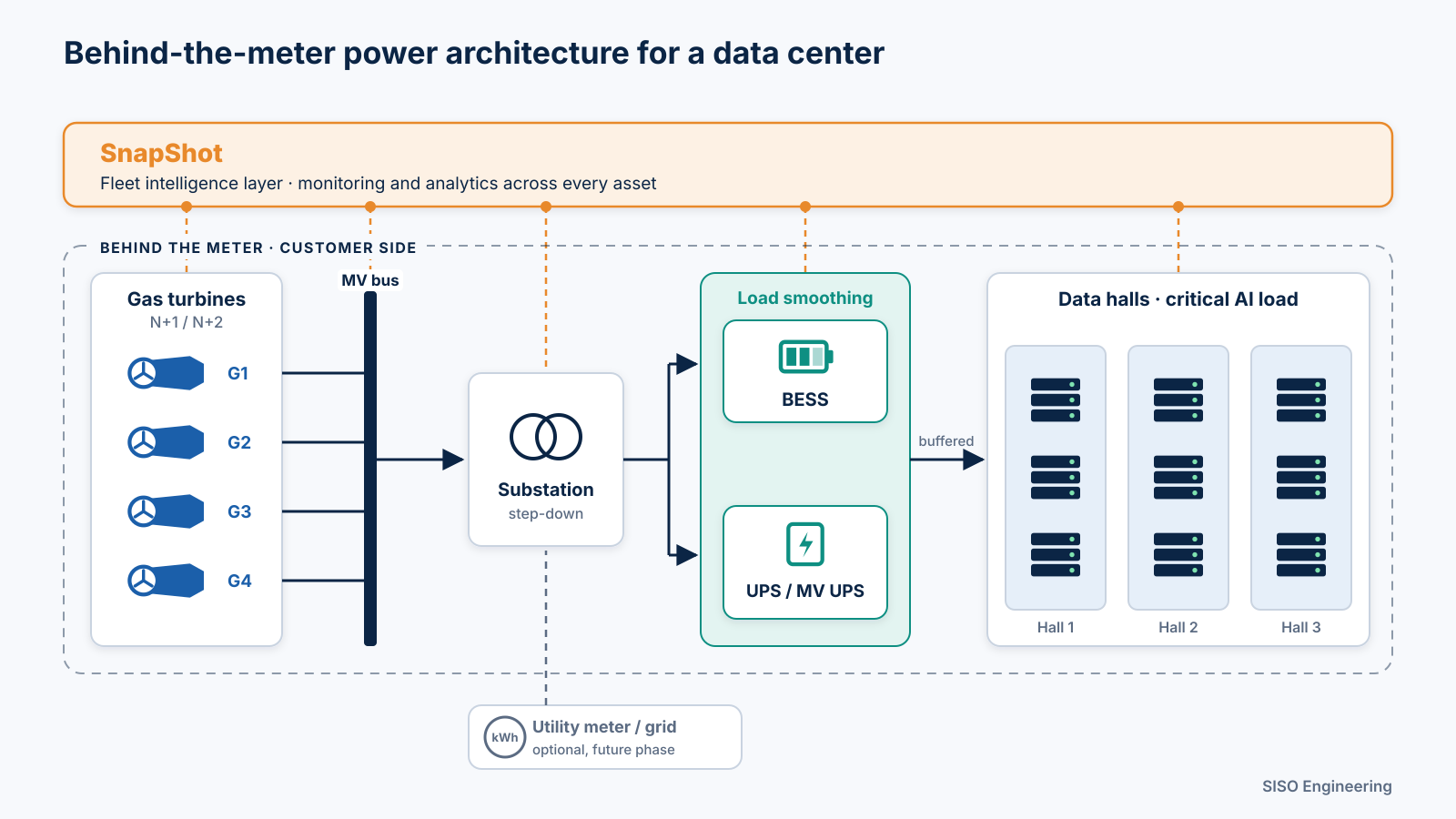
The developers building this way are not choosing behind-the-meter power because the grid doesn’t exist. They’re choosing it because AI infrastructure needs power faster than most interconnection queues can deliver. A hyperscaler’s power contract also runs 15 to 20 years. That is long enough that “the equipment works” and “the system works, continuously, for two decades” are different questions.
That second question, whether the assembled system performs on schedule and keeps performing, is where interface risk lives. Ten vendors each sign off on their own scope. They include the generation OEM, BESS supplier, UPS and electrical OEMs, engineering, procurement, and construction (EPC) firm, owner’s engineer, utility or independent system operator (ISO), data-center electrical contractor, controls vendor, and operations and maintenance (O&M) provider. The plant can still trip on a load step, fail to island cleanly, or need redesign to expand, because nobody owned the seams between them.
Why Are Data Centers Turning to Behind-the-Meter Generation?
Most developers land on behind-the-meter generation because the interconnection queue and the hyperscaler’s timeline are incompatible, not because grid power failed them. Equipment availability now shapes the architecture as much as demand does. Turbine slot reservations and electrification equipment backlogs mean the developer has to design around what can be procured on schedule, not an ideal fleet on paper.
The demand behind that pressure is documented. The U.S. Department of Energy summarizes Lawrence Berkeley National Laboratory’s 2024 report on U.S. data center energy use. It states that data centers consumed about 4.4% of total U.S. electricity in 2023 and projects approximately 6.7 to 12% by 2028 (U.S. Department of Energy, 20 Dec 2024). In Texas, ERCOT told the state Senate Business & Commerce Committee that it was tracking approximately 410 GW of large loads seeking interconnection, and about 87% of them were data centers (ERCOT, 1 Apr 2026, data as of 26 Mar 2026). Those are interconnection requests, not confirmed load. These are external market indicators, not SISO Engineering projects.
Four forces are converging on the same answer:
- Speed to power. A phased, behind-the-meter build can start serving load in a fraction of the time a full grid interconnection takes, especially where aeroderivative units offer fast-start, factory-assembled deployment.
- Reliability targets that exceed what a single utility feed guarantees. Hyperscaler contracts increasingly specify four, five, or six nines of availability. The on-site generation, not the grid alone, has to be built to meet that target.
- Control over operations. A behind-the-meter plant is not held to the same grid interconnection requirements, so the owner decides when its generation starts and stops.
- Optionality. Most facilities don’t stay behind-the-meter forever. They start islanded, add a partial grid interconnection, and eventually become fully grid-interconnected as the facility and the market mature. The controls and protection design therefore has to work for every phase from day one, not be redesigned at each one.
External market reporting shows the scale this model is already reaching. GE Vernova booked $2.4B in electrification equipment orders supporting data centers in Q1 2026 alone, more than all of 2025, against a reported 100 GW gas turbine backlog plus slot reservations. These figures are as reported by the manufacturer, cited as a demand indicator, and are not SISO Engineering projects (GE Vernova, “GE Vernova reports first quarter 2026 financial results and raises 2026 guidance,” 22 Apr 2026, gevernova.com). Separately, GE Vernova and Crusoe announced a 29-unit aeroderivative gas turbine deal for AI data centers. The announced figures are roughly 1 GW from LM2500XPRESS units, about 35 MW per unit, a five-minute start, and about 95% factory assembly. This is also not a SISO Engineering project (GE Vernova press release, “GE Vernova and Crusoe announce major 29-unit aeroderivative gas turbine deal,” 22 Jul 2025, gevernova.com). Hyperscaler behind-the-meter deals like these now set the pattern other developers are building toward.

Before the architecture is locked, the fix is cheap. After, it's a change order.
The conversation starts with a SISO engineer. Bring your equipment list, single-line diagram, and schedule, and talk through how the turbines, battery storage, UPS, and controls on your project will communicate, be commissioned together, and be monitored as one fleet.
What Is SISO Engineering's Role in Behind-the-Meter Data Center Power?
SISO Engineering’s role starts with SnapShot, its fleet intelligence layer. A behind-the-meter facility can combine aeroderivative gas turbines, industrial gas turbines, heavy-duty frame gas turbines, steam turbines, reciprocating engines, battery storage, balance-of-plant systems, several OEMs, and different control platforms, all supporting one critical load. SnapShot gives developers, data center operators, and investors a unified view of generation performance across that mixed fleet. It does not require every asset to come from the same manufacturer or run on the same control system.
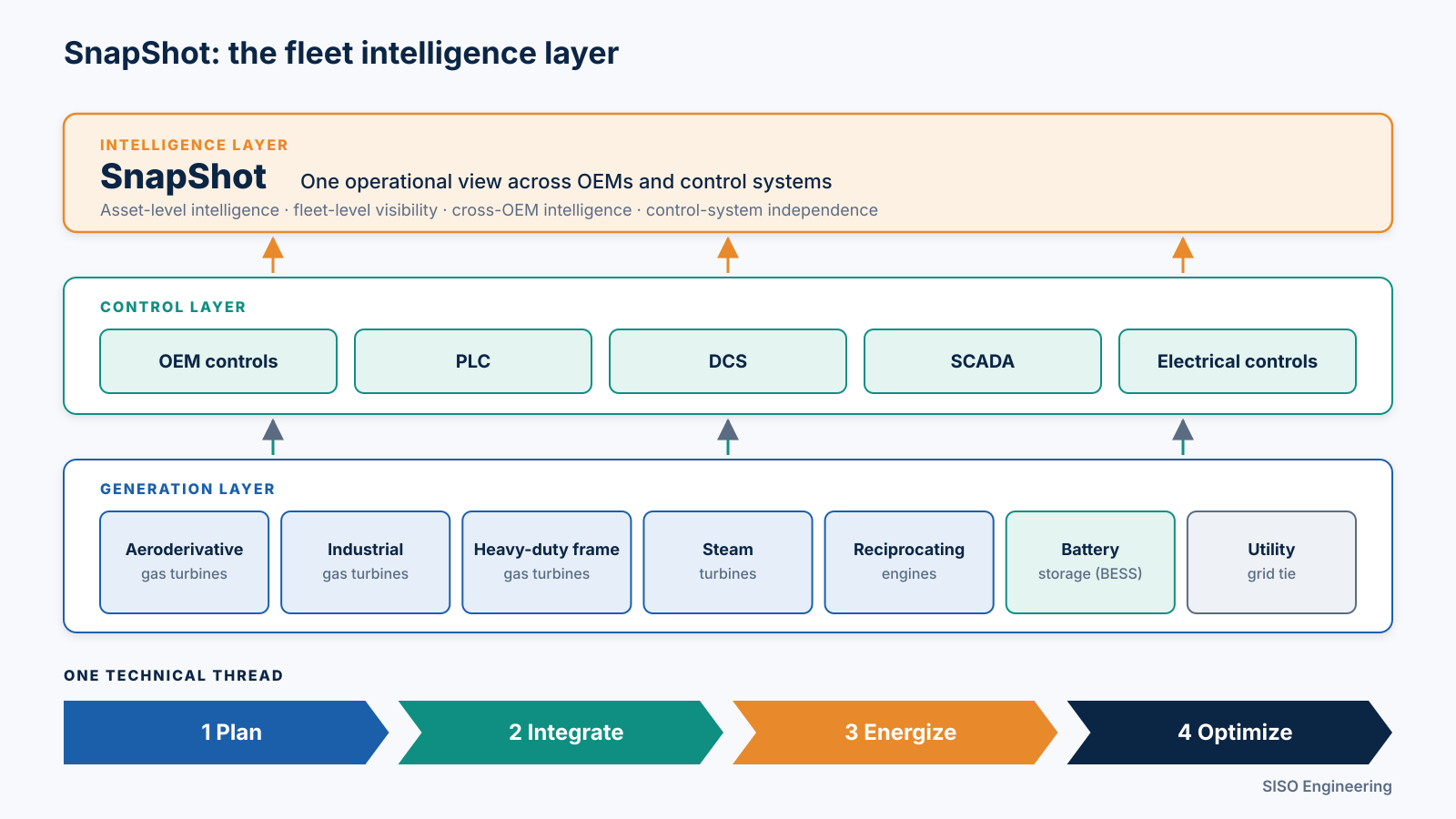
Different assets. Different OEMs. Different controls. One operational intelligence layer.
SnapShot moves a team from asset monitoring to fleet intelligence:
- Asset-level intelligence: operating conditions, performance indicators, trends, alarms, deviations, and equipment behavior at the individual-unit level.
- Fleet-level visibility: a comparison of assets across a site or portfolio on performance, availability, operating behavior, and maintenance requirements.
- Cross-OEM intelligence: one operational view across equipment from different manufacturers, without forcing the owner into a single-OEM ecosystem.
- Control-system independence: information from multiple control environments in one analytics layer, while existing plant control systems keep performing their core control functions.
Controls run the plant. SnapShot helps you understand it. Plant control and asset dispatch stay with your distributed control system (DCS) and energy management system (EMS). Full plant optimization remains with your control and operations teams, supported by SnapShot’s insights.
How SISO Engineering engages. SISO Engineering is the integration layer that brings communication together once the equipment is ordered. It gets turbines, battery storage, UPS, and balance-of-plant systems talking to one another. It then sits on top of those systems and collects data across them, showing the correlations and interfaces between systems that are otherwise delivered as separate silos and rarely compared side by side. The work follows one technical thread, and SnapShot is where that thread continues once the plant is running:
- Plan: data and monitoring strategy, covering which signals each system needs to share and how they will be collected.
- Integrate: OEM and EPC technical coordination; controls engineering across GE Vernova Mark VIe (ControlST), Emerson Rx3i (Machine Edition), Woodward MicroNet (GAP), Allen-Bradley (ControlLogix), and multi-OEM platforms; data integration through the Matrix Box and Turbine Data Collection System (TDCS); and interoperability verification.
- Energize: system commissioning support, integrated test scenarios, performance baseline capture, and troubleshooting during start-up.
- Optimize: SnapShot monitoring and analytics, performance and RAM (reliability, availability, maintainability) tracking, engineering support and asset reviews, and lifecycle and expansion support.
Working with your equipment suppliers and partners. MV UPS, static synchronous compensator (STATCOM), and BESS equipment comes from the suppliers who make it. SISO Engineering helps support that equipment and advises on how it should behave and integrate with the gas turbine fleet. SISO Engineering works alongside the EPC, the owner’s engineer, the generation OEMs, the utility, the independent system operator or regional transmission organization (ISO/RTO), and the lender’s independent engineer.
Where Does SnapShot Enter a Behind-the-Meter Project?
SnapShot enters once the equipment is ordered, at whichever stage the project is in.
- In construction and commissioning. As equipment enters service, SnapShot monitors it and captures the operational baseline and performance information that every later comparison is measured against.
- Already operating, including a plant already supporting a data center. SnapShot aggregates operational information from existing and newly deployed generation assets and provides continuous fleet visibility. As the facility grows, it integrates additional generation assets and technologies and preserves operational history and engineering intelligence throughout the life of the plant.
How Does an AI Load Change the Power Plant Design?
AI training load does not behave like a traditional industrial load, and a behind-the-meter plant has to be designed around that difference, not just around nameplate megawatts. When large accelerator clusters synchronize, facility demand can step by a large fraction of peak in seconds, then step back down, repeatedly. That behavior has to be evaluated as a set of dynamic system studies, not a single load-flow calculation. The studies cover load step changes, ramp rate, transient and frequency response, voltage stability, reserve margin, turbine/UPS/BESS response, thermal and mechanical stress, and torsional interaction.
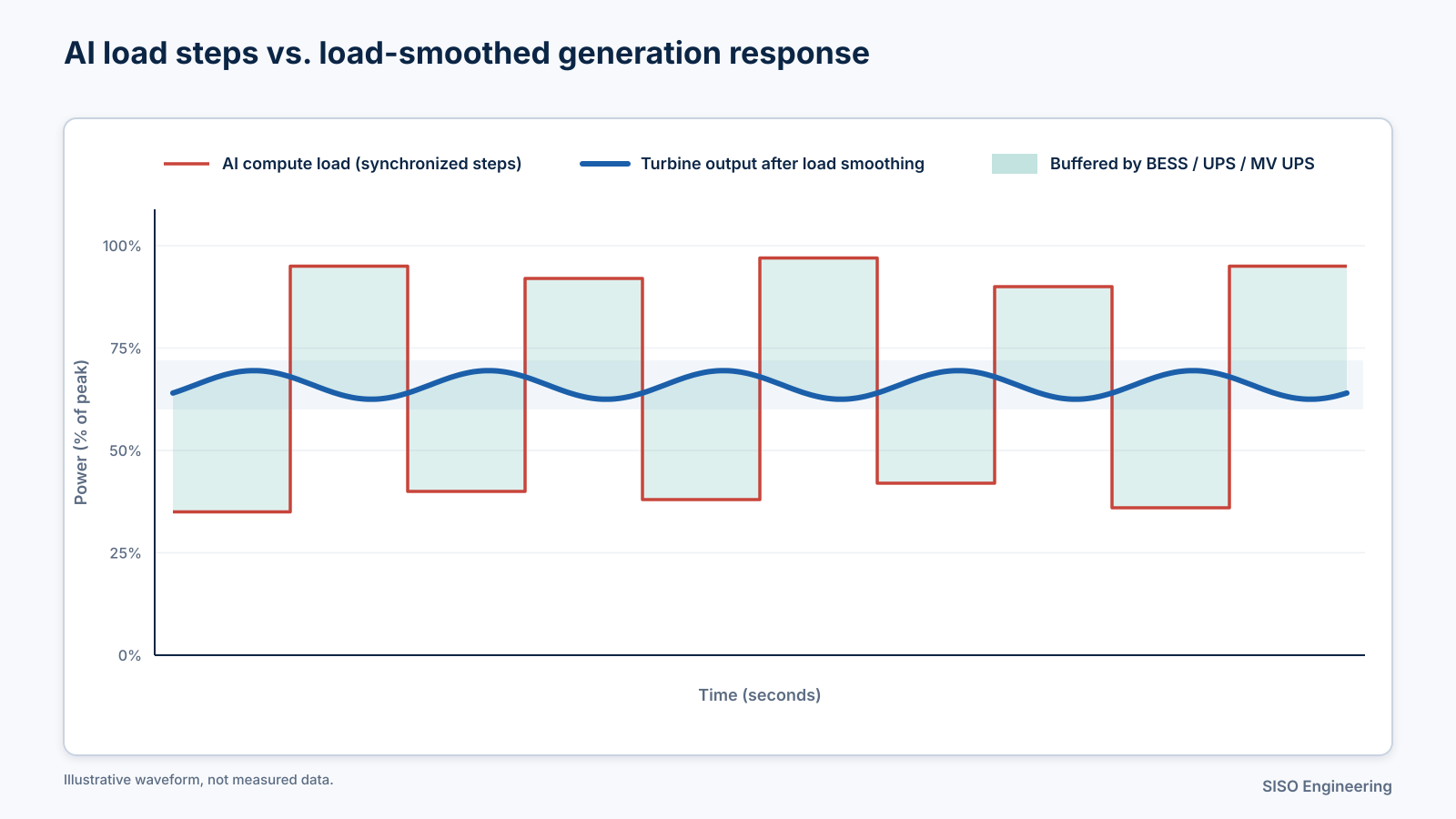
The architecture answer is load smoothing: putting fast-response assets such as UPS, MV UPS, BESS, and other power electronics between the compute load and the rotating machinery. Used deliberately, they buffer, shape, and rate-limit what the turbines see, so generation operates inside a controlled envelope instead of chasing raw load steps. That reduces rapid cycling and mechanical and torsional stress on the prime movers, improves frequency response, contributes operating reserve, and protects power quality at the data hall.
SnapShot analyzes how the assembled system performs under real AI load behavior. SISO Engineering monitors how the fast-response equipment behaves with the gas turbines and flags anomalies and abnormal behavior. Plant control and asset dispatch stay with the DCS and EMS, and SnapShot is the monitoring and analytics layer on top of them. MV UPS, STATCOM, and BESS equipment comes from the suppliers who make it.
How Is a Behind-the-Meter Plant Commissioned and Energized?
Every OEM commissions and signs off on its own equipment. The turbine works, the BESS works, the switchgear works, the UPS works, the controls work. All of them can be right and the assembled plant can still fail as a system. A single factory test never exercises islanding transitions, a turbine trip under N+1 contingency, or BESS response and handoff. It never exercises black-start sequencing, first data-hall energization, frequency and voltage excursions, or source-transfer scenarios. It never exercises N+2 and multi-contingency events, a communications failure between control systems, or the tie-in of the next expansion phase.
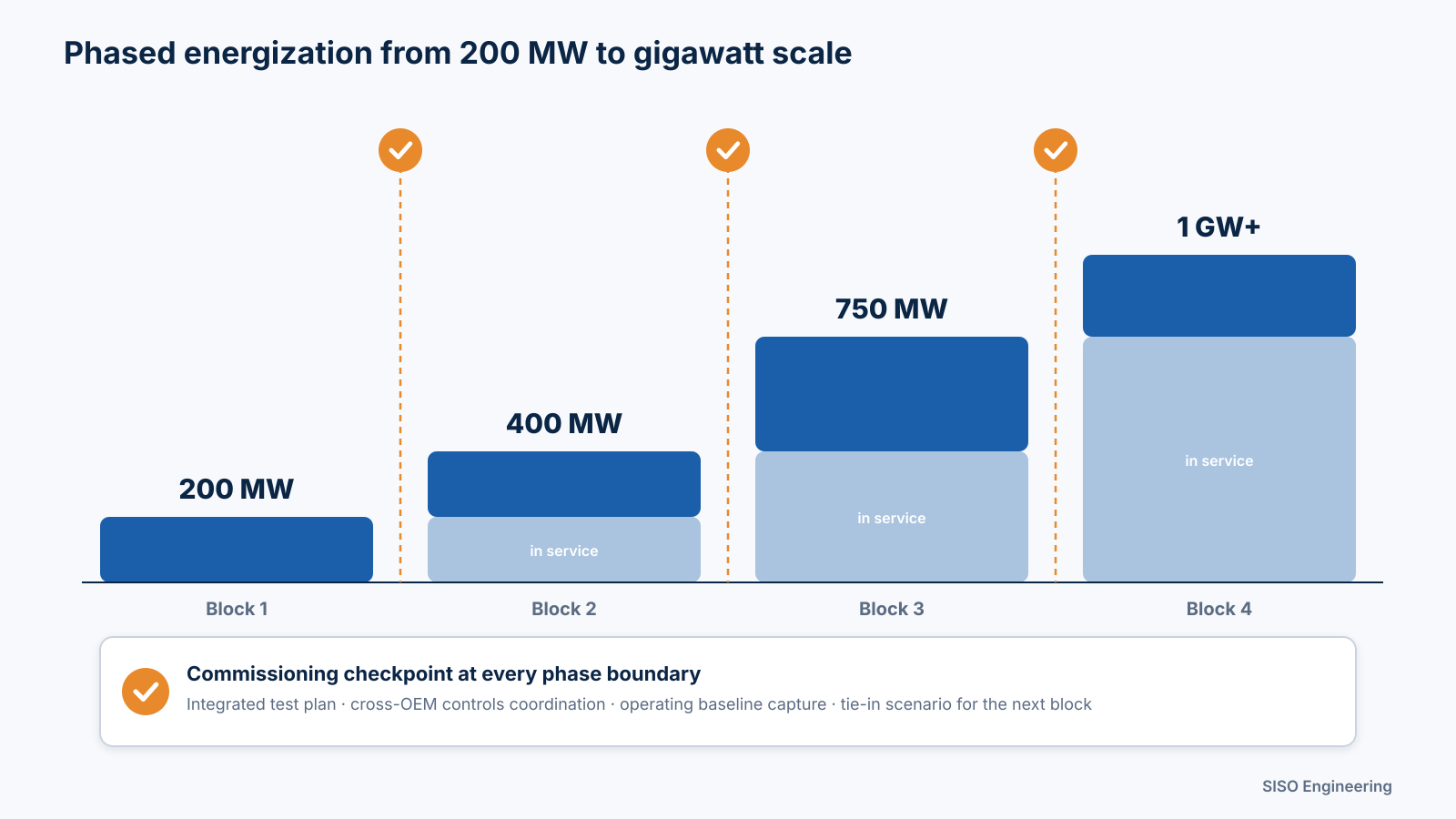
SISO Engineering’s role at this stage is system integration, commissioning assurance, and quality assurance: the integrated test plan, cross-OEM controls coordination, and the operating baseline captured during energization. Each OEM commissions its own equipment, and SISO Engineering supports the system-level test plan around it.
Most AI facilities energize in blocks: 200 MW, then 400, then 750, then a gigawatt or more. Each block has to be fully operable on its own, with its own reserve, protection, and black-start capability, while staying compatible with a facility configuration that doesn’t exist yet. Fault levels rise as units are added, protection coordination shifts, and new units have to come onto the bus without disturbing data halls already under contract. That’s why the controls and protection design has to anticipate the final facility from day one, and why each phase’s commissioning plan has to include the tie-in scenario for the next.
Does Behind-the-Meter Power Make a Data Center Project Bankable?
Bankability is the standard project-finance term for whether lenders and investors will finance a project on reasonable terms. It rests on five things, not one equipment brand:
- Technology: proven generation, a credible OEM, achievable availability.
- Development: site control, fuel, permits, a realistic schedule.
- Contractual: a credible offtaker and defined availability obligations.
- Operational: whether performance can be measured, investigated, and validated over time.
- Expansion: whether Phase II will destabilize Phase I.
SnapShot, and the SISO Engineering team behind it, is directly relevant to the operational and expansion components.
An infrastructure investor’s risk stack settles the first four layers (CapEx, schedule, offtake, and technology certainty) largely by financial close. The last two, operating certainty and lifecycle transparency, are proven or disproven every day of a 15- to 20-year contract. That’s where SnapShot’s continuity of operating evidence matters. It captures the as-commissioned baseline during energization and watches for early-operation settling behavior. It trends performance against that baseline and supports remote investigation of deviations. It also compares each new expansion block against the plant that’s already under contract.
Bankability comes from several components working together, and SnapShot contributes the operating record: a continuous history of how the plant has actually performed, captured from commissioning onward. That record strengthens the operational transparency and lifecycle evidence that the investor, the lender, and the hyperscaler offtaker each look for, even though each defines “bankable” a little differently. Lender technical advisors and independent engineers get better evidence to work with, and so does the developer.

What SISO Engineering Brings and How It Works With Your Team
What SISO Engineering brings:
- SnapShot: subscription monitoring and analytics that turns operating data into fleet intelligence and a lifecycle record, from commissioning baseline through expansion.
- Controls engineering across GE Vernova Mark VIe (ControlST), Emerson Rx3i (Machine Edition), Woodward MicroNet (GAP), Allen-Bradley (ControlLogix), and multi-OEM platforms.
- Integration that gets separate systems communicating once equipment is ordered, then shows how those systems interact.
- Coordination of technical interfaces between the EPC, generation OEMs, BESS and UPS suppliers, utility and ISO, and data-center electrical contractor.
- System-level commissioning support: integrated test plans, cross-OEM controls coordination, quality assurance, and operating baseline capture.
How SISO Engineering works with your systems and partners:
- Plant control and asset dispatch stay with your DCS and EMS. Controls run the plant. SnapShot helps you understand it.
- Full plant optimization remains with your control and operations teams, supported by SnapShot’s insights.
- SISO Engineering works alongside the EPC, the owner’s engineer, the generation OEMs, the utility, the ISO/RTO, and the lender’s independent engineer.
- MV UPS, STATCOM, and BESS equipment comes from the suppliers who make it. SISO Engineering helps support that equipment and advises on how it should behave and integrate with the gas turbine fleet.
- Each OEM commissions its own equipment, and SISO Engineering supports the system-level test plan around it.
- Bankability comes from five components working together. SnapShot strengthens the operational and expansion components with a continuous operating record.
SISO Engineering’s goal is to strengthen the work of every partner on your project, making the entire power system more reliable, understandable, and operable.
What Has SISO Engineering Done in Behind-the-Meter and Resilience Work?
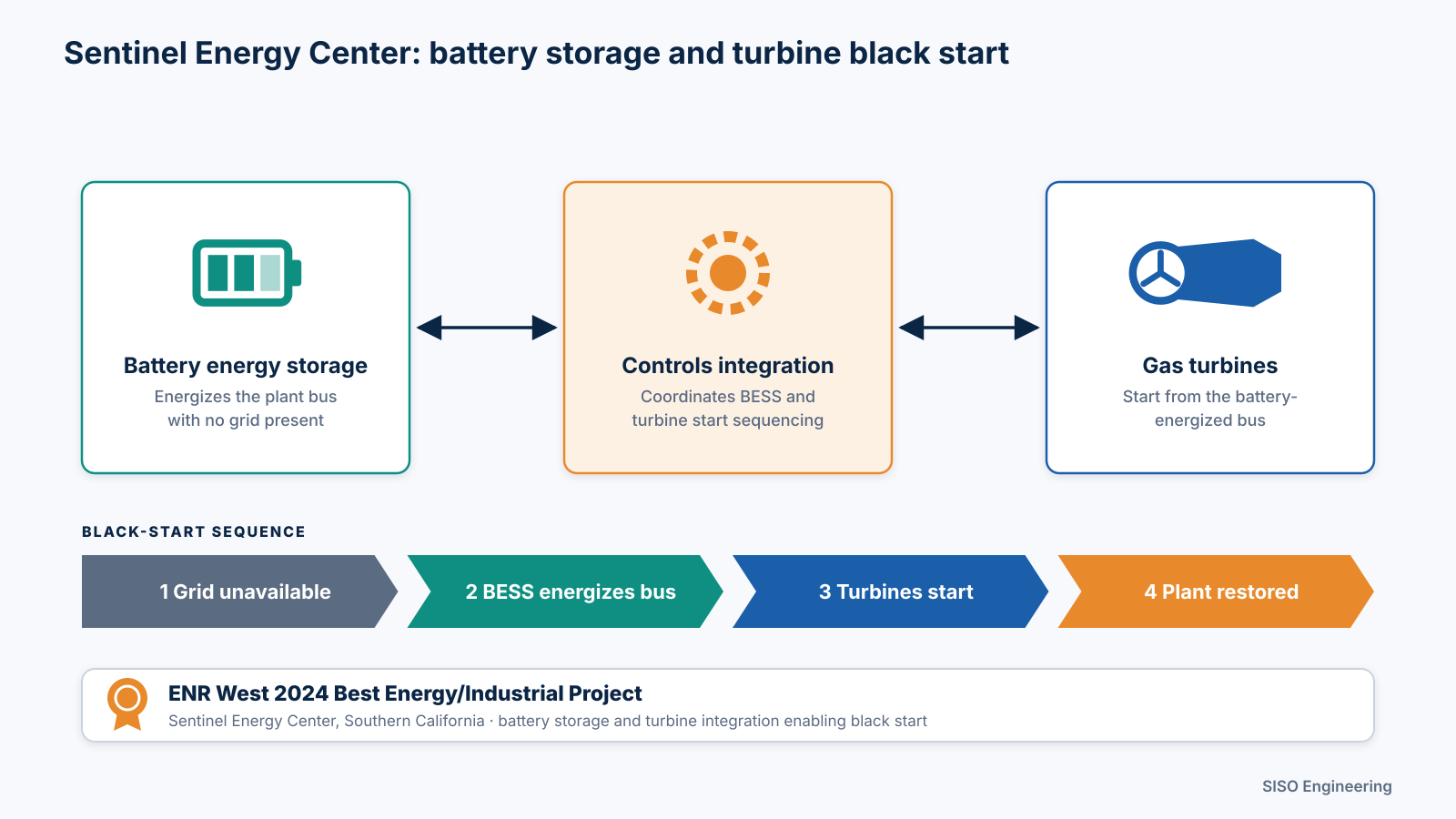
SISO Engineering’s data-center work is new; its controls and resilience track record is not. The clearest bridge between the two is the Sentinel Energy Center project in Southern California. SISO Engineering’s six-year controls engagement at the facility gave it the institutional knowledge behind a battery storage and turbine integration project enabling black-start capability. That project received the ENR West 2024 Best Energy/Industrial Project award.
Two further projects show the same discipline behind-the-meter plants depend on. Both involve fast, coordinated response when a turbine has to come back online or a facility has to recover under pressure:
- Restarting When It Matters: Turbine Blackstart Restoration: an LMS100 black-start restoration project.
- When Every Minute Counts: Emergency Outage Recovery: rapid-response engineering on a two-unit Frame 5 outage.
- Controls Integration Enables an Award-Winning Energy Storage System with Black Start: the Sentinel Energy Center case study behind the ENR award.
Black-start and islanding capability are exactly what a behind-the-meter data-center plant depends on: the ability to bring generation back online without relying on the grid, and to run isolated from it when needed. This is where SISO Engineering proved that capability, on a different asset class, before carrying it into data-center work.
FAQs
What does "behind-the-meter" mean for a data center?
Behind-the-meter means the generation, typically gas turbines and battery storage, sits on the customer’s side of the utility meter. It serves the data center’s load directly, instead of power flowing in from the grid through a utility interconnection. A behind-the-meter data center can run partially or fully islanded from the grid, depending on how it’s designed.
Why are data center developers choosing behind-the-meter generation over grid interconnection?
Mainly speed, reliability, and control. For a conventional power plant, lost generation is a commercial problem. For a data center, loss of generation can become a mission-critical infrastructure event. Interconnection queues often can’t match hyperscaler timelines, and behind-the-meter generation can be built to hit contractual availability targets (four, five, or six nines) that a single utility feed doesn’t guarantee on its own. Regulation plays a part too: a behind-the-meter plant is not held to the same grid interconnection requirements, so the owner decides when its generation starts and stops.
What equipment is typically used in behind-the-meter data center power?
Most designs combine aeroderivative gas turbines (valued for fast start, modularity, and N+1 or N+2 redundancy) with battery energy storage (BESS). The BESS provides fast transient support and load smoothing. UPS or medium-voltage UPS (MV UPS) buffers the load the turbines see. Industrial and heavy-duty frame gas turbines, steam turbines, or combined-cycle units sometimes anchor baseload in larger blocks.
Does SISO Engineering manufacture or supply the turbines, BESS, or UPS?
No. Generation equipment, MV UPS, STATCOM, and BESS come from their manufacturers, and SISO Engineering sells no generation equipment. SISO Engineering helps support that equipment and advises on how it should behave and integrate with the gas turbine fleet, integrates the controls and data, and analyzes the resulting system behavior. SnapShot, SISO Engineering’s fleet intelligence layer, sits on top of that equipment and its controls.
How does SISO Engineering work with our EPC and owner's engineer?
SISO Engineering works alongside your EPC, owner’s engineer, generation OEMs, utility, ISO/RTO, and lender’s independent engineer. SnapShot gives all of them a shared view of how the plant performs, and SISO Engineering’s controls integration gets their systems communicating. SISO Engineering’s goal is to strengthen the work of every partner on your project, making the entire power system more reliable, understandable, and operable.
How does AI compute load affect the power plant design?
AI training clusters can swing demand by a large fraction of peak in seconds, repeatedly, a pattern traditional industrial loads don’t produce. That requires dynamic system studies (load step, ramp rate, transient and frequency response, and torsional interaction). It also requires load-smoothing equipment: fast-response assets like BESS and UPS positioned between the compute load and the rotating machinery, so the turbines operate inside a controlled envelope.
Where does SISO Engineering work on behind-the-meter data center power projects?
SISO Engineering works on behind-the-meter data center power projects across North America, South America, and Europe, wherever the equipment runs. Texas is the home market, and SISO Engineering brings deep ERCOT and SPP experience, but the work is not limited to those grids.
Let's Talk Through Your Power Architecture Before the Critical Decisions Are Locked In
Start with a conversation with a SISO engineer. SnapShot then carries one fleet intelligence layer through commissioning, operations, and expansion.
Houston, Texas · Serving North America, South America, and Europe
Technically reviewed by Max Erwin (CEO & Co-Founder) and Kellan McCarthy (CTO & Co-Founder), SISO Engineering.