
Engineering Consultant Services
Hybrid Power Systems: Gas Turbine + Battery Storage
An AI data center’s load does not look like a gas turbine’s rated output. SISO Engineering’s SnapShot platform gives a hybrid plant one fleet intelligence layer across its turbines, batteries, and controls, and SISO Engineering’s controls integration and commissioning support on turbine and battery storage projects is how it gets into a project. The goal is one plant, not two systems that happen to share a bus. The battery energy storage system (BESS) and the power electronics come from the suppliers who make them, and SISO Engineering works across those suppliers.
- Founded 2018, Houston, Texas
- General Electric (GE)-background leadership: CEO Max Erwin (10+ years at GE) and CTO Kellan McCarthy (18+ years of gas turbine experience)
- Engineering News-Record (ENR) West 2024 Best Energy/Industrial Project: Sentinel Energy Center
A hybrid power system pairs gas turbines with a battery energy storage system (BESS) and fast power electronics so that the two behave as one electrical asset rather than two separate ones. AI data centers need this pairing because synchronized training loads can swing facility demand by a large share of peak capacity in seconds. A turbine fleet cannot follow a step that fast on its own. The BESS and power electronics carry the transient while the turbines hold the baseload.
Why Can't a Gas Turbine Fleet Alone Carry an AI Data Center's Load?
Traditional industrial loads are steady, ramp slowly, and forgive a slow response. AI training clusters do not behave that way. When thousands of accelerators synchronize a training step, facility demand can swing by a large fraction of peak in seconds, then step back and forward again, repeatedly, all day.
A rotating machine has physical limits on how fast it can change output without mechanical and torsional stress. Asked to follow that load directly, a turbine fleet either overbuilds capacity it rarely uses or wears out faster than its design life allows.
The North American Electric Reliability Corporation (NERC) Large Loads Task Force reports that large loads can shift their consumption in seconds, much quicker than conventional generators can ramp. Its white paper shows one North American data center ramping down from about 450 MW to about 40 MW within 36 seconds (NERC, Characteristics and Risks of Emerging Large Loads, July 2025). These figures are industry context as reported by NERC, not a SISO Engineering project or result.
This is not a turbine problem to solve with a bigger turbine. It is a system-design problem: something has to sit between the compute and the rotating machinery and absorb the shape of the load before it reaches the prime mover. That is the role BESS and power electronics play in a hybrid system. It is why a data-center developer or BESS integrator should ask a different question. Not “which turbine handles this load,” but “how does the whole portfolio behave together?”

What Is a Hybrid Gas Turbine + Battery Power System?
A hybrid power system combines two or more generation and storage assets under one controls and protection strategy. Most often that means an aeroderivative or heavy-duty gas turbine fleet plus a battery energy storage system (BESS). The assets are engineered to work as a single system. They are not independently commissioned equipment that happens to share an electrical bus.
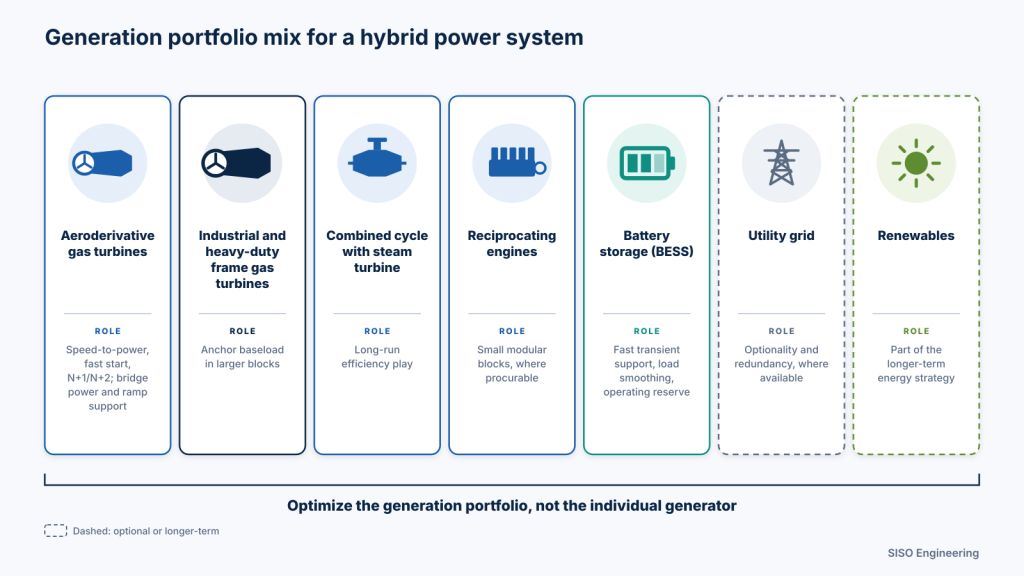
The underlying principle: don’t optimize the individual generator, optimize the generation portfolio. Aeroderivative gas turbines buy speed-to-power, modularity, fast start, and N+1/N+2 redundancy, and they are well suited as bridge power and ramp support. Industrial and heavy-duty frame gas turbines anchor baseload in larger blocks, while combined cycle, which adds steam turbines, is the long-run efficiency play. Reciprocating engines add small modular blocks where they can be procured. BESS provides fast transient support, load smoothing, and operating reserve. The grid, where available, is optionality and redundancy. Renewables and, longer-term, nuclear are part of the energy strategy. Each asset class does a different job, and none of them does all of the jobs alone.
What Is the Fleet Intelligence Layer for a Hybrid Power System?
A hybrid facility mixes aeroderivative gas turbines, industrial and heavy-duty frame gas turbines, steam turbines, reciprocating engines, battery storage, balance-of-plant systems, and several original equipment manufacturers (OEMs), each on its own control platform. SnapShot brings those assets together through one fleet intelligence layer. Different assets. Different OEMs. Different controls. One operational intelligence layer.
SnapShot aggregates and contextualizes operational information across the turbines, engines, battery storage, balance-of-plant equipment, and multiple control-system environments on the site. Operators get a common view of how each asset is behaving and how the fleet is performing together, without being forced into a single-OEM ecosystem. Existing plant control systems keep performing their core control functions. The control system operates the equipment. SnapShot helps the organization understand the equipment.

For a conventional power plant, lost generation is a commercial problem. For a data center, loss of generation can become a mission-critical infrastructure event. SnapShot helps power teams find operational problems earlier and understand them faster, before those problems affect availability.
Where does SnapShot enter a hybrid project? Once equipment is ordered, at one of two points. During construction and commissioning, SnapShot monitors equipment as it enters service and captures the operational baseline. On a plant already operating, it provides continuous fleet visibility and integrates additional generation assets as the facility grows.
Read more about SnapShot gas turbine monitoring and analytics.
How Does Turbine and Battery Storage Integration Work?
SnapShot is the fleet intelligence layer. The integration and commissioning work below is how SISO Engineering gets into a project, and it sets up what SnapShot monitors afterward.
The integration burden of a mixed fleet is real. Different asset classes carry different inertia, different ramp rates, different protection behavior, and different OEM control platforms. That burden lands in controls, protection, and reserve. This is the layer SISO Engineering works in: once the equipment is ordered, SISO Engineering gets the systems communicating, then sits on top of them and collects data across them. Different equipment, one operating strategy.
In practice the work follows four steps:
- Plan. Map the data and monitoring strategy and the technical interfaces between the turbine fleet, the BESS, and the power electronics, so each system’s signals can be shared.
- Integrate. Coordinate controls engineering across OEM platforms, integrate the data, and verify that the assets interoperate.
- Energize. Support system commissioning with integrated test scenarios, and capture a performance baseline.
- Optimize. Track performance and RAM (reliability, availability, maintainability) over the life of the plant, with SnapShot monitoring and engineering support.
Each OEM continues to commission its own equipment, and SISO Engineering works alongside them. SnapShot sits on top of the control and data layers. Plant control and asset dispatch stay with the distributed control system (DCS) and energy management system (EMS). Controls run the plant. SnapShot helps you understand it.
How Do Batteries and Power Electronics Smooth AI Load Swings?
The architecture answer to the AI-load problem is to put fast-response assets between the compute and the rotating machines. Those assets are uninterruptible power supplies (UPS), medium-voltage UPS (MV UPS), BESS, and other power electronics. Their job is not only backup power. Used deliberately, they shape the load so the turbines and engines see a rate-limited demand curve instead of a raw step. That improves system stability, reduces rapid cycling, lowers mechanical and torsional stress on the prime movers, contributes operating reserve, and protects power quality at the data hall.
Where SISO Engineering fits next to the equipment suppliers. MV UPS, static synchronous compensators (STATCOM), and BESS come from the suppliers who make them. SISO Engineering helps support that equipment and advises on how it should behave and integrate with the gas turbine fleet, integrates the controls and data, and analyzes the resulting system behavior. The developer still buys the BESS from its supplier and the UPS from its power-electronics OEM, and the suppliers build the hardware. SISO Engineering gets those systems communicating with the turbine controls, tests how the assembled system performs, and monitors for anomalies and abnormal behavior.

What Roles Do Spinning Reserve and BESS Response Play in a Hybrid System?
On a behind-the-meter or islanded site, black start, spinning reserve, and frequency control are entirely local, and there is no utility to lean on. Spinning reserve is capacity a turbine fleet keeps on standby to absorb a contingency without a frequency excursion. BESS response is the fast, sub-second layer that buys the turbine governors time to react.
Getting both sizing and dispatch right is a system study, not a nameplate calculation. It depends on load step size, ramp rate, and the reliability target. That target is N+1 or N+2, plus how many nines of availability the contract requires. It also depends on how the BESS is expected to hand off to the turbines during a transition.
None of this is something a single OEM’s factory test can validate, because no single OEM controls the whole system. It has to be studied and commissioned as one plant.
What Has to Be Tested That a Factory Commissioning Test Can't Cover?
Every OEM commissions its own equipment and signs off that it works. All of them can be right, individually, and the plant can still fail as a system. For a mission-critical load, that gap is the risk that matters. The scenarios a factory test does not cover are the ones between suppliers:
- Islanding transitions
- A data-hall load step
- A turbine trip with the remaining units picking up load (an N+1 contingency)
- The BESS response and handoff during that trip
- Black start
- First data-hall energization
- Frequency and voltage excursions
- Transfer scenarios
- Multiple simultaneous contingencies
- A communications failure between control systems
- The tie-in of the next expansion phase onto a live bus
SISO Engineering’s role in this phase is integration, commissioning assurance, and quality assurance: the integrated test plan, cross-OEM controls coordination, and the operating baseline captured during energization. Each OEM commissions its own equipment, and SISO Engineering works alongside them.
How Is a Hybrid Facility Commissioned in Phases?
A commissioning strategy for these scenarios has to be written early. Phased commissioning and phased energization are design decisions, not end-of-project tasks. Facilities are typically energized in blocks: 200 MW, then 400, then 750, and beyond.
Each block has to be fully operable on its own, with its own reserve, protection, and black-start capability, and it also has to stay compatible with a facility configuration that does not exist yet. That path is preserved only when the controls design, protection scheme, and BESS strategy are planned in the first phase to anticipate later expansion. The alternative is redesigning the plant each time it grows.
Has Gas Turbine and BESS Integration Been Done Before?
Yes, at the system level, though not yet at AI-data-center scale. Sentinel Energy Center in Southern California is not a data center. It is SISO Engineering’s clearest existing proof point for turbine-and-battery integration. Its Black Start project won the ENR West 2024 Best Energy/Industrial Project award.
SISO Engineering has supported the facility’s control systems since 2018. For the Black Start project, that six-year institutional knowledge informed new control narratives, custom HMI displays, and balance-of-plant coordination logic. Together they let the battery-powered Black Start system and the site’s gas turbines act as one integrated system, not two separately commissioned ones. The system has since been activated twice following separate utility disturbances, and in both cases the facility restored generation independently. That was validated under real operating conditions, not only test scenarios.
The project is a smaller, single-site version of the integration problem a hybrid AI-facility power system has to solve. Turbine and battery behavior are coordinated under one controls narrative. The seams between them are explicitly owned rather than left to each supplier’s own assumptions.
Read the full case study: Controls Integration Enables Award-Winning Energy Storage System with Black Start. Related project: Restarting When It Matters: Turbine Blackstart Restoration.
Are Fast-Start Turbine Blocks Being Built for Data Centers?
GE Vernova and Crusoe announced a deal for 29 LM2500XPRESS aeroderivative gas turbine packages for AI data centers. The deal totals roughly 1 GW, at about 35 MW per unit. Each unit is capable of a roughly five-minute start time and is reported as approximately 95% factory-assembled. Small, modular, fast-start blocks like these are the building blocks a phased, N+1 hybrid facility is designed around. Pairing that kind of generation with BESS and power electronics is the pattern this page describes. These figures are external market validation as publicly reported by the parties, not a SISO Engineering project or claim of involvement (GE Vernova press release, “GE Vernova and Crusoe announce major 29-unit aeroderivative gas turbine deal,” 22 Jul 2025, gevernova.com).
Talk to a SISO Engineer About Your Hybrid Plant
The conversation starts with a SISO engineer. Bring your equipment list and schedule, and talk through how the turbines, battery storage, and power electronics on your project will communicate, be commissioned together, and be monitored as one fleet.
Who Owns the Interfaces Between Turbine, BESS, and UPS Suppliers?
The developer holds a set of separate relationships. They include the turbine OEM, the BESS supplier, the UPS or power-electronics OEM, the engineering, procurement, and construction (EPC) contractor, the owner’s engineer, and the utility or independent system operator / regional transmission organization (ISO/RTO). Each one is responsible for its own equipment behaving correctly. None of them, individually, is responsible for the interfaces between the equipment.
Those interfaces include the turbine OEM’s ramp-rate assumption against the BESS supplier’s response envelope, the UPS transfer behavior against the protection engineer’s settings, and the data-hall load profile against the generation dispatch approach. A plant where every component passes its own factory test can still trip on a load step, fail to island cleanly, or need redesign the first time it expands.
Why Use an Independent Integrator Instead of OEM Commissioning Alone?
SISO Engineering’s background is gas turbine controls and automation across GE Vernova Mark VIe (ControlST), Emerson Rx3i (Machine Edition), Woodward MicroNet (GAP), Allen-Bradley (ControlLogix), and multi-OEM platforms. That is the layer where interface risk lives in a mixed fleet. SISO Engineering works alongside the EPC, the owner’s engineer, the OEMs, the utility, and the ISO, getting their systems communicating, coordinating controls and data integration across suppliers, and analyzing how the assembled system performs. The interface risk is owned by someone instead of left unassigned between the separate scopes of work. After energization, SnapShot keeps the record of how those interfaces perform, as one fleet intelligence layer across the suppliers.
Geography: SISO Engineering works across North America, South America, and Europe, wherever the equipment runs. Texas, within the Electric Reliability Council of Texas (ERCOT) and Southwest Power Pool (SPP) footprints, is SISO Engineering’s home market and an area of deep expertise.
FAQs
What is a hybrid gas turbine and battery storage system?
A hybrid power system pairs gas turbines with battery energy storage (BESS) and fast power electronics under one controls and protection strategy. The assets respond to load as a single coordinated system instead of independently commissioned equipment sharing a bus. It typically includes a mix of generation types (aeroderivative, industrial, or heavy-duty frame gas turbines, sometimes combined cycle with steam turbines or reciprocating engines) plus BESS for transient response and reserve.
What does SnapShot add to a hybrid gas turbine and battery plant?
SnapShot is SISO Engineering’s fleet intelligence layer. It aggregates and contextualizes operational information across turbines, engines, battery storage, balance-of-plant equipment, and multiple control-system environments, giving operators one view of how each asset and the whole fleet are performing. Plant control stays with the plant control systems. SnapShot enters once equipment is ordered, during construction and commissioning or on a plant that is already operating.
Why does an AI data center need battery storage if it already has gas turbines?
Synchronized AI training loads can swing facility demand by a large share of peak capacity in seconds, then swing back, repeatedly. Gas turbines cannot follow a step that fast without mechanical and torsional stress. Battery storage and power electronics absorb that transient shape, presenting the turbines with a smoother, rate-limited load instead of a raw step.
Does SISO Engineering manufacture the battery storage system or the MV UPS equipment?
No. The hardware comes from its manufacturers, and the developer buys the MV UPS, STATCOM, and BESS from its chosen suppliers. SISO Engineering helps support that equipment and advises on how it should behave and integrate with the gas turbine fleet, integrates the controls and data, and analyzes the resulting system behavior. SISO Engineering’s role is the integration layer between the suppliers.
What is spinning reserve, and why does it matter for a hybrid system?
Spinning reserve is generation capacity held ready to absorb a contingency, such as a tripped unit or a sudden load step, without a frequency excursion. On a behind-the-meter or islanded site, spinning reserve and black start are entirely local; there is no utility to fall back on. Sizing it correctly depends on the reliability target (N+1 or N+2), the load’s ramp rate, and how the BESS is expected to hand off to the turbines during a transition.
What does "islanding" mean in this context, and why does it need to be commissioned specifically?
Islanding is operating the site’s generation independent of the wider grid, whether by design (behind-the-meter) or in response to a grid disturbance. Every OEM commissions its own equipment. But no single OEM’s factory test covers the islanding transition itself, the moment the turbine, BESS, and protection systems have to hand off from grid-connected to independent operation together. That scenario has to be tested at the system level, not assumed from individual equipment sign-offs.
Can a hybrid system scale from a smaller first phase to a much larger facility later?
That is a design decision, not a given. Facilities are typically energized in blocks: 200 MW, then 400, then 750, and beyond. Each block has to be fully operable on its own, with its own reserve and protection, while also staying compatible with a facility configuration that does not exist yet. Preserving that path means planning the controls design, protection scheme, and BESS strategy from the first phase to anticipate later expansion, not redesigning the plant each time it grows.
Has SISO Engineering integrated turbine and battery storage systems before?
Yes, at the system-controls level. The Sentinel Energy Center Black Start project is SISO Engineering’s proof point for integrating BESS and gas turbine controls into one operating system. Sentinel is in Southern California and is not a data center. The project won the ENR West 2024 Best Energy/Industrial Project award. It included control narratives, human-machine interface (HMI) design, and balance-of-plant coordination logic. The system has restored generation independently after two separate utility disturbances since commissioning.
Does SISO Engineering replace the EPC or the battery storage system's own OEM commissioning team?
No. SISO Engineering works alongside the EPC, the owner’s engineer, the OEMs, the utility, and the ISO, and each OEM commissions its own equipment. SISO Engineering’s work is the layer above that: it gets the assets communicating with the gas turbine fleet, integrates the controls and data, and runs the system-level test scenarios (islanding, contingencies, black start) that a single OEM’s factory commissioning leaves between the suppliers.
Working Alongside Your Major Partners
SISO Engineering’s goal is to strengthen the work of every partner on your project, making the entire power system more reliable, understandable, and operable.
Technically reviewed by Max Erwin (CEO & Co-Founder) and Kellan McCarthy (CTO & Co-Founder), SISO Engineering.