
Engineering Consultant Services
What Is Powered Land?
The definition, the bankability chain behind it, and where SnapShot, SISO Engineering’s fleet intelligence layer, fits. For developers, landowners, and investors building mission-critical power for data centers across North America, South America, and Europe.
Powered land is a site that already has, or has a credible path to, the things a large power buyer needs: acreage, fuel access, and a real position on the electric grid. That position is typically an interconnection queue slot or a behind-the-meter generation option inside a grid operator’s footprint, such as the Electric Reliability Council of Texas (ERCOT) or the Southwest Power Pool (SPP) in Texas, PJM Interconnection in the Mid-Atlantic, or the California Independent System Operator (CAISO). Powered land is a starting position. It is not, by itself, a working power plant, and it is not yet a bankable asset.
- Founded 2018, Houston, Texas
- GE-background leadership: CEO Max Erwin (10+ years at GE) and CTO Kellan McCarthy (18+ years of gas turbine experience)
- ENR West 2024 Best Energy/Industrial Project: Sentinel Energy Center, Southern California
What Is Powered Land?
Powered land describes real estate that carries power potential beyond the raw acreage: a substation nearby, an active interconnection application, gas availability, or a combination of the three. In every market, that potential is framed against the local grid operator, because interconnection position, queue status, and market rules differ from one operator to the next. In Texas, SISO Engineering’s home market, that usually means ERCOT or SPP. Elsewhere it may be PJM, the Midcontinent Independent System Operator (MISO), CAISO, or another operator.
The term has grown popular because AI data-center developers need power faster than the traditional grid-interconnection timeline allows, so sites with an existing power advantage command a premium. That premium is real. It is also, on its own, incomplete. The rest of this page covers what makes a powered-land position bankable, and what it takes to keep that position operable after energization.
What powered land is not: a permit is not a plant. An interconnection study is not a commissioned system. A letter of intent from a gas supplier is not fuel under contract. Powered land is the opening move in a longer chain, not the finished asset a hyperscaler, lender, or investor is actually buying.
Why Isn't a Substation Study Enough Anymore?
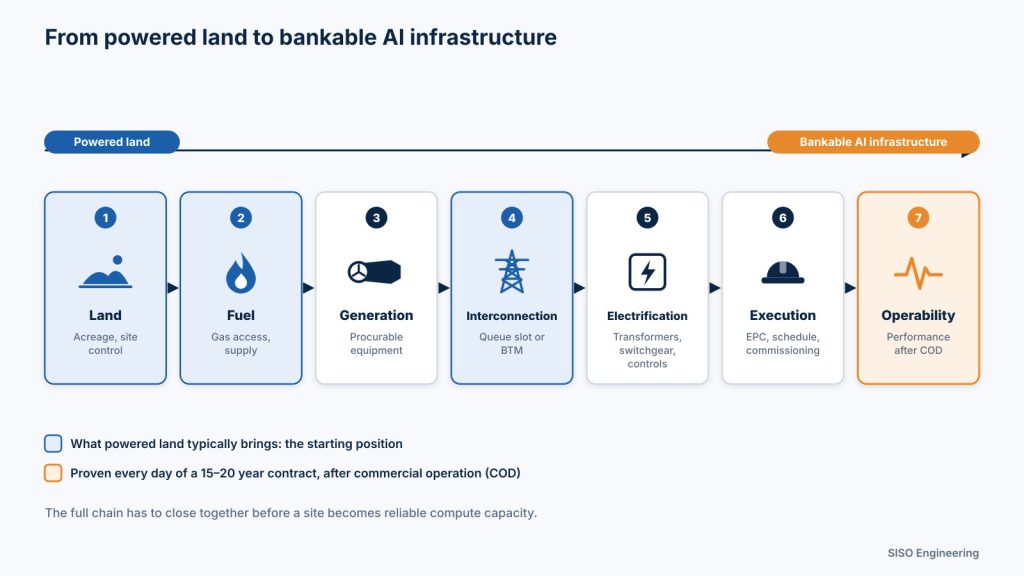
Because the constraint on an AI data-center project has moved. It used to be land. Now it is the full chain that has to close together. That chain is land, fuel, generation, interconnection, electrification, execution, and operability after the site is energized (commercial operation date, or COD). Electrification is the transformers, switchgear, protection, and controls that connect generation to the load.
A site can have strong land and a real interconnection position and still fail to close a data-center deal, because the buyer isn’t purchasing acreage or a queue slot. The buyer is purchasing reliable compute capacity, delivered on a schedule, for a contract that runs fifteen to twenty years. Powered land is not the finished product. Reliable compute capacity is.

Equipment availability compounds the problem. GE Vernova reported roughly 100 GW of gas turbine backlog plus slot reservations in its first-quarter 2026 results (GE Vernova, 22 Apr 2026; a manufacturer’s figure, not a SISO Engineering project). The equipment a developer can actually procure, not the equipment that would be ideal on paper, now shapes the plant from day one.
Demand is the other half of the squeeze. The U.S. Department of Energy summarizes Lawrence Berkeley National Laboratory’s 2024 report on U.S. data center energy use. It states that data centers consumed about 4.4% of total U.S. electricity in 2023 and projects approximately 6.7 to 12% by 2028 (U.S. Department of Energy, 20 Dec 2024). In Texas, ERCOT told the state Senate Business & Commerce Committee that it was tracking approximately 410 GW of large loads seeking interconnection, and about 87% of them were data centers (ERCOT, 1 Apr 2026, data as of 26 Mar 2026). Those are interconnection requests, not confirmed load. These are external market indicators, not SISO Engineering projects.
What Makes Powered Land Bankable?
Bankability is the standard project-finance term for whether lenders and investors will finance a project on reasonable terms. It is not one thing. It’s five, and equipment brand answers only one of them:
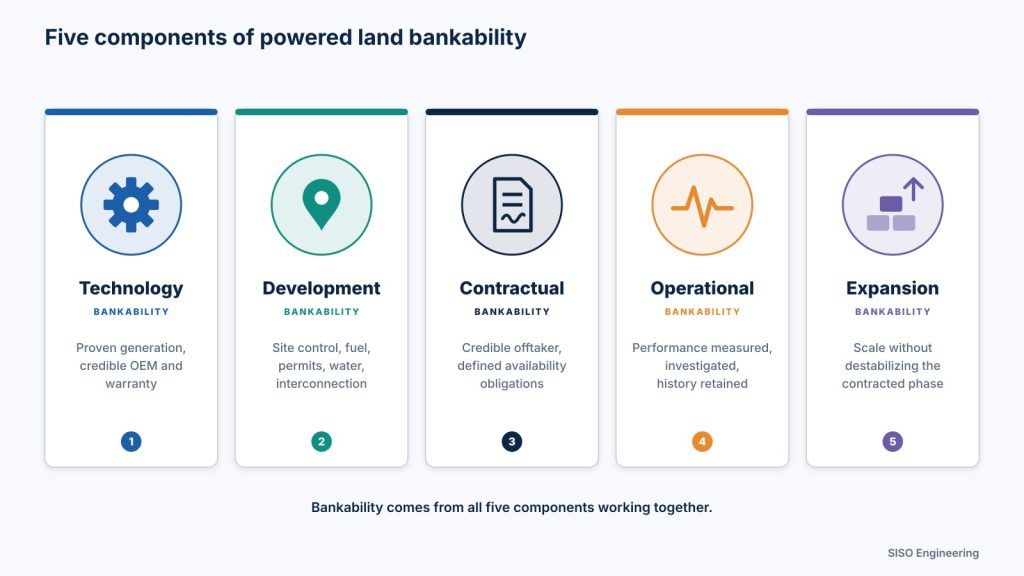
- Technology bankability: proven generation technology, a credible original equipment manufacturer (OEM) and warranty, known maintenance requirements, achievable availability.
- Development bankability: site control, fuel, permits, water, a real transmission and interconnection strategy, a realistic schedule, an identified engineering, procurement, and construction (EPC) firm.
- Contractual bankability: a credible offtaker, long-duration revenue visibility, defined availability and performance obligations.
- Operational bankability: whether performance can be measured, problems found and investigated, operating history retained, and maintenance risk managed.
- Expansion bankability: whether a later phase will destabilize the phase already under contract, and whether the plant can scale without redesign.
Investors look at the same question as a risk stack: CapEx certainty, schedule certainty, offtake certainty, technology certainty, operating certainty, and lifecycle transparency. The first four are largely settled by financial close: the budget, the schedule, the power-purchase agreement, and the OEM contract. The last two, operating certainty and lifecycle transparency, are proven or disproven every day of a fifteen- to twenty-year contract. That is where continuous, independent operating evidence earns its keep. A generation-capacity claim with no operating record behind it stops being convincing to a lender’s independent engineer or an investor’s diligence team.
Before the critical decisions are locked in.
The conversation starts with a SISO engineer. Talk through how SnapShot will bring a powered-land position’s mixed generation fleet into one view as equipment is commissioned, so new capacity is monitored alongside what is already running.
Why Doesn't Generation Capacity Without Reliability Evidence Close a Data-Center Deal?
Because the three buyers evaluating a powered-land position are not asking “how many megawatts.” They’re asking whether those megawatts will show up, on schedule, for the life of the contract.
- The hyperscaler wants to know how fast compute can go online. It wants to know whether the system can meet its contractual availability target (measured in nines) and whether power quality will support sensitive AI hardware. It also asks whether the site can scale from 200 MW to 1 GW without redesign, and whether the operator can demonstrate performance instead of merely asserting it.
- The infrastructure investor wants predictable revenue, a credible offtaker, and, critically, operating data and clear risk allocation, not just proven equipment on a spec sheet.
- The lender wants an enforceable contract, a proven technology, and an operating history it can actually see, alongside reserve accounts and a real maintenance plan.

Consider a powered-land site with strong acreage and a strong interconnection position. If it has no plan for how the mixed generation fleet will be commissioned, coordinated, and monitored as one system, it asks all three buyers to take reliability on faith. None of them will.
What Is SISO Engineering's Role in Powered Land Development?

SISO Engineering’s role starts with SnapShot, its fleet intelligence layer for powered-land and data-center power. A powered-land facility may begin with 10 or 20 MW of bridge generation, expand to 100 MW, and ultimately become an integrated energy facility of several hundred megawatts. Equipment arrives in phases from different manufacturers, so the facility ends up with mixed generation, mixed OEMs, and mixed controls. SnapShot gives developers, power producers, and infrastructure investors one view of generation performance across that fleet.
Different assets. Different OEMs. Different controls. One operational intelligence layer.
SnapShot works at four levels. Asset-level intelligence tracks operating conditions, trends, alarms, and deviations on each unit. Fleet-level visibility compares assets across the site or portfolio. Cross-OEM intelligence builds a common operational view across manufacturers. Control-system independence brings multiple control environments into one analytics layer, while existing plant control systems keep performing their core control functions.
The intelligence architecture scales with the facility. Phase 1 is the initial generation assets, and phase 2 adds capacity. Phase 3 may bring utility interconnection or grid participation. Phase 4 may add battery storage, renewables, or additional thermal generation. Controls run the plant. SnapShot helps you understand it.
Where SnapShot enters. SnapShot enters once equipment is ordered, at whichever stage the project is in:
- A project in construction and commissioning, including a data-center power plant being built. As equipment is commissioned, SnapShot monitors it and creates the operational baseline, capturing performance information as each unit enters service.
- A plant already operating, including one already supporting a data center. SnapShot aggregates operational information from existing and newly deployed generation assets and provides continuous fleet visibility. As the facility grows, it integrates additional assets and technologies and preserves operational history and engineering intelligence throughout the life of the plant.
How SISO Engineering gets into a project. SISO Engineering’s services work is how it gets into a project. Its background is gas turbine controls and automation across GE Vernova Mark VIe (ControlST), Emerson Rx3i (Machine Edition), Woodward MicroNet (GAP), Allen-Bradley (ControlLogix), and multi-OEM platforms. That is the layer where interface risk lives on a mixed generation fleet. The work follows one technical thread, and SnapShot is where that thread continues once the plant is running:
- Plan: data and monitoring strategy, covering which signals each system needs to share and how they will be collected.
- Integrate: OEM and EPC technical coordination, controls engineering across those platforms, data integration, and interoperability verification.
- Energize: system commissioning support, integrated test scenarios, performance baseline capture, and troubleshooting during start-up.
- Optimize: SnapShot monitoring and analytics; performance, RAM (reliability, availability, maintainability), and compliance tracking; engineering support and asset reviews; lifecycle and expansion support.
The same engineers who integrate and commission the system are the ones watching it run afterward. The operating intent isn’t lost at the handoff between construction and operations.
What SISO Engineering Brings to a Powered-Land Project and How It Works With Your Team
SnapShot brings:
- Fleet intelligence: asset-level intelligence, fleet-level visibility, and cross-OEM intelligence in a lifecycle operating record that supports the bankability case after COD.
SISO Engineering’s services bring:
- Coordination of controls and commissioning across a mixed generation fleet (turbines, battery energy storage systems (BESS), switchgear, protection).
- Integration support for third-party equipment, including medium-voltage uninterruptible power supply (MV UPS), static synchronous compensator (STATCOM), and BESS. SISO Engineering helps understand how that equipment is behaving together with the gas turbine fleet and integrates the controls and data across it.
How it fits with your systems and partners:
- Plant control and asset dispatch stay with your distributed control system (DCS) and energy management system (EMS). SnapShot sits on top of the control and data layers and helps the owner understand what the data means. Controls run the plant. SnapShot helps you understand it.
- Full plant optimization remains with your control and operations teams, supported by SnapShot’s insights.
- SISO Engineering works alongside the EPC, the owner’s engineer, the generation OEMs, the utility, the independent system operator or regional transmission organization (ISO/RTO), and the lender’s independent engineer.
- MV UPS, STATCOM, and BESS equipment comes from the suppliers who make it. SISO Engineering helps understand how that equipment is behaving together with the gas turbine fleet, integrates the controls and data, and analyzes the resulting system behavior.
- Each OEM commissions its own equipment, and SISO Engineering supports the system-level test plan around it.
- SnapShot supports the operational transparency and lifecycle evidence that strengthens the overall bankability story, and bankability comes from several components working together.
SISO Engineering’s goal is to strengthen the work of every partner on your project, making the entire power system more reliable, understandable, and operable.
How Does SnapShot Support Powered Land Bankability?
SnapShot is SISO Engineering’s subscription-based monitoring solution for gas turbines, control systems, and other power generating assets. Across a mixed fleet, it works as the fleet intelligence layer for the whole site. On a powered-land project, its role is to create continuity of operating evidence across the asset’s life. It captures the as-commissioned baseline at first energization and watches for early-operation issues. It trends output and equipment health over time and supports fault investigation.
For a developer, that means an operating record that exists from day one instead of being reconstructed after a problem occurs. It gives engineering visibility into the fleet without adding permanent site headcount. It also gives the offtaker and the lender a running record of how the plant performs.
Plant control and asset dispatch stay with the developer’s DCS and EMS. SnapShot is a monitoring and analytics layer that sits on top of the control layer. That distinction matters to any owner’s engineer or lender’s independent engineer reviewing the plant.
How Do ERCOT, SPP, and Other Grid Operators Affect Powered Land?
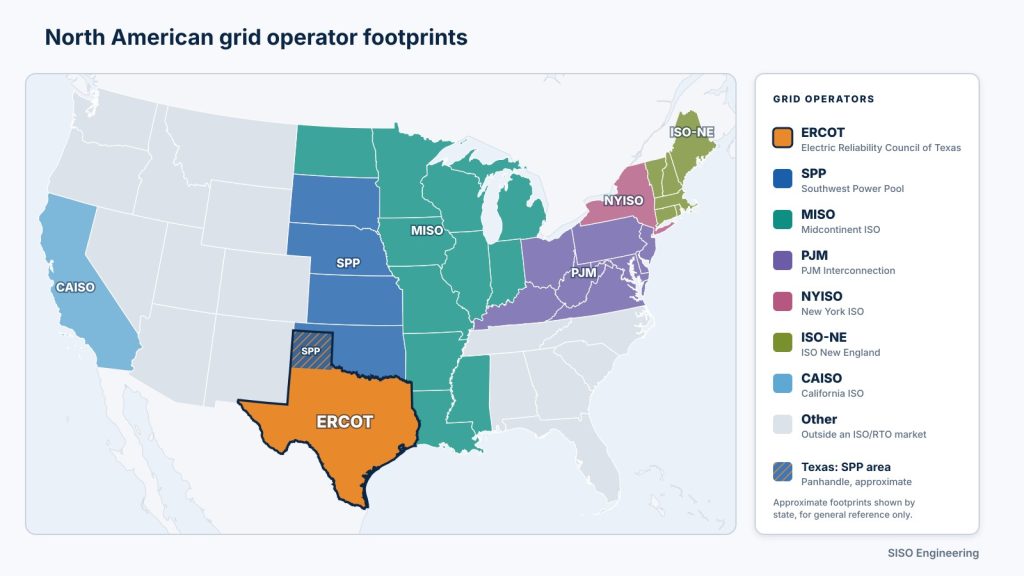
Every grid operator has its own interconnection queue, market structure, and behind-the-meter rules, so the same powered-land questions play out differently in each market. In North America, that includes ERCOT, the Southwest Power Pool (SPP), PJM Interconnection, the Midcontinent Independent System Operator (MISO), the California Independent System Operator (CAISO), the New York Independent System Operator (NYISO), and ISO New England. SISO Engineering works across North America, South America, and Europe, wherever the equipment runs.
Texas is SISO Engineering’s home market and the clearest worked example. A Texas powered-land site sits inside one of two grid footprints. ERCOT serves most of the state and runs its own interconnection process and market, largely separate from the rest of the U.S. grid. SPP is the regional transmission organization that covers parts of the Texas Panhandle and West Texas along with several other central U.S. states. The two operate under different interconnection queues, different market structures, and different rules for behind-the-meter (BTM) generation, meaning generation that serves a load directly without necessarily flowing through the public grid.
A powered-land position typically starts in one of a few configurations. It can be fully behind-the-meter and islanded, where on-site generation carries the load, with black start and frequency control handled locally. It can be a hybrid model with limited grid interconnection for import, export, or reserve sharing. It can also be a path toward full ISO/RTO interconnection later. Which configuration a site starts in, and how much room it has to move to the next one without redesigning the controls and protection scheme underneath it, are among the first decisions a developer has to get right.
Proof This Discipline Holds Up Under Real Conditions
SISO Engineering’s six-year controls and analytics engagement at the Sentinel Energy Center in Southern California informed the award-winning black-start integration project on that facility’s battery-and-turbine system (ENR West 2024 Best Energy/Industrial Project). SISO Engineering applies the same institutional knowledge and one-technical-thread discipline to powered-land and data-center work.
A powered-land position is bankable when it is also operable.
Talk to a SISO engineer about building SnapShot’s fleet intelligence into the plant as equipment is commissioned, so the operating record starts on day one.
FAQs
What is powered land?
Powered land is a site that already has, or has a credible path to, the acreage, fuel access, and grid position that a large power buyer needs. That grid position is typically an interconnection option with the local grid operator, such as ERCOT or SPP in Texas, PJM, MISO, or CAISO. It’s a starting position for a power development project, not a finished, operating power plant.
Is powered land the same as a data-center site?
Not exactly. A data-center site is the property where the compute load will sit. Powered land describes the power advantage a site carries: generation potential, fuel access, or interconnection position. That advantage exists whether or not a data center is built on that specific parcel or served from it behind the meter.
What makes a powered-land position bankable?
Bankability is the standard project-finance term for whether lenders and investors will finance a project on reasonable terms. It has five parts: proven technology, development readiness (site control, permits, fuel, schedule), contractual strength (a credible offtaker and defined obligations), operational transparency (whether performance can be measured and proven), and expansion durability (whether a later phase will destabilize the one already under contract). For a conventional power plant, lost generation is a commercial problem. For a data center, loss of generation can become a mission-critical infrastructure event, which is why operational transparency carries real weight.
What does SISO Engineering do on a powered-land project?
SnapShot is SISO Engineering’s fleet intelligence layer for the project. It gives the developer one view across mixed generation, mixed OEMs, and mixed controls, and it carries the lifecycle operating record that supports the bankability case. SISO Engineering’s services work covers controls integration and commissioning support across the fleet. MV UPS, STATCOM, and BESS equipment comes from the suppliers who make it, and SISO Engineering helps understand how that equipment is behaving together with the gas turbine fleet, integrates the controls and data, and analyzes the resulting system behavior. SISO Engineering works alongside the EPC, the OEMs, the owner’s engineer, and the utility.
Does SnapShot make a powered-land project bankable by itself?
No. Bankability comes from several components working together. SnapShot contributes the operating record: a continuous history of how the plant has actually performed, captured from commissioning onward and kept for the life of the asset. That record supports the operational transparency and lifecycle evidence lenders and investors look for, alongside proven technology, contractual strength, and a sound development plan.
How do ERCOT, SPP, and other grid operators affect a powered-land position?
Each grid operator runs its own interconnection queue and market rules. In Texas, SISO Engineering’s home market, most powered-land sites fall under ERCOT or the Southwest Power Pool (SPP). Elsewhere in North America, the operator may be PJM, MISO, CAISO, NYISO, or ISO New England, and markets in South America and Europe have their own. The grid a site sits in shapes its interconnection timeline, its behind-the-meter options, and how the plant should be designed to keep options open as its grid relationship changes.
What's the first step in evaluating a powered-land position?
Talk to a SISO engineer. The first conversation covers where your project is today, whether equipment is being commissioned or the plant is already running, and how SnapShot can bring the fleet into one view and start the operating record.
Powered Land Is the Start
Bankable, operable, scalable power infrastructure is the value. Let’s talk through your power architecture before the critical decisions are locked in.
Houston, Texas · Serving North America, South America, and Europe
Technically reviewed by Max Erwin (CEO & Co-Founder) and Kellan McCarthy (CTO & Co-Founder), SISO Engineering.